
Why is industrial 3D printing irreplaceable? High-performance materials, multicolor printing, and optical-grade finishes


The Industrial 3D printing vs. home 3D printing It is no longer a matter of scale but rather one of technical integrity. While the home 3D printing market of 2026 has achieved notable milestones, industrial manufacturing remains the only way to produce parts with engineering certifications, optical-grade transparency, and precise repeatability. In this article, we explore why professional services such as those offered by Justway are the necessary standard when a project goes beyond a visual prototype and requires actual functionality.
Beyond the Prototype: The Performance Gap Between Domestic and Industrial Applications
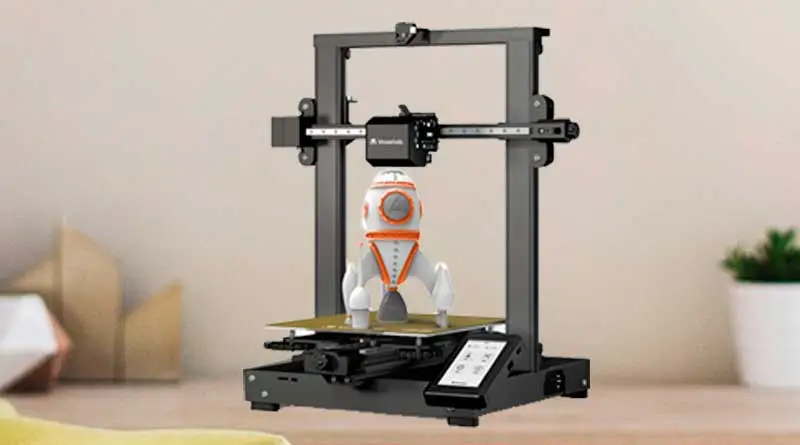
The choice between Industrial 3D printing vs. home 3D printing should not be based on the initial cost, but rather on the final performance of the part. While a desktop 3D printer is excellent for rapid, low-commitment iterations, industrial manufacturing ensures that every micron of the design translates into a measurable physical property.
| Feature | Home 3D Printing (Desktop) | Industrial 3D Printing (Justway) |
| Dimensional Tolerance | ±0.2 mm to ±0.5 mm (variable) | ±0.05 mm to ±0.1 mm (ISO standard) |
| Technical Materials | Limited (PLA, PETG, basic ABS) | PEEK, Ultem, Metal, Carbon Nylon |
| Repeatability | Low (depends on manual calibration) | Start (closed-loop processes) |
| Special Finishes | Handmade / Artisanal | Optical Grade, Anodized, 2K Clear Coat |
| Certifications | Not available | ISO 9001, UL 94, Medical Grade |
Repeatability and ISO tolerance standards
In industrial manufacturing, consistency is a measure of quality, not a coincidence. Professional-grade systems use closed-loop sensors that monitor the print head position and material flow in real time. This enables the achievement of tolerances that meet industry standards ISO 2768, ensuring that if you order 100 hydraulic connectors, the first one and the 100th one will fit into your assembly with the same micrometer-level precision.
Structural integrity and layer density
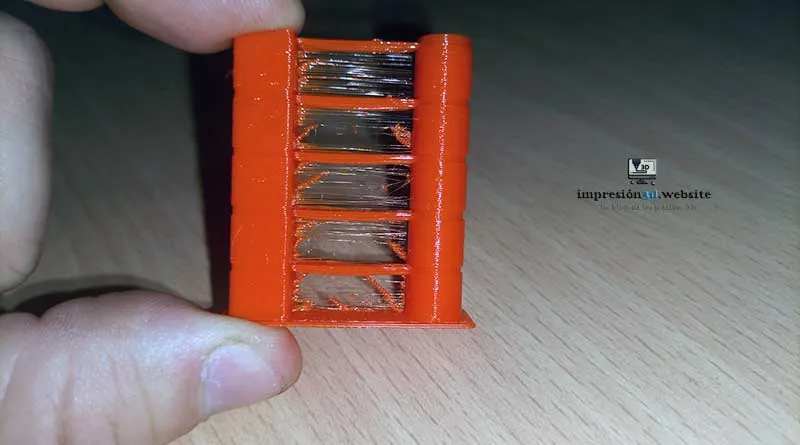
One of the critical issues that is often overlooked in home printing is the anisotropy (the part's weakness along the Z-axis). Industrial machines are equipped with actively heated chambers that maintain the ambient temperature just below the material's glass transition temperature.
This isn't just to avoid the warping; the real goal is to maximize the intermolecular fusion between layers. The result is a piece with a density of up to 99.9%, whose mechanical properties come dangerously close to those of a plastic injection-molded part, eliminating the catastrophic failure points commonly found in the home environment.
Engineering materials: when PLA and PETG are no longer enough
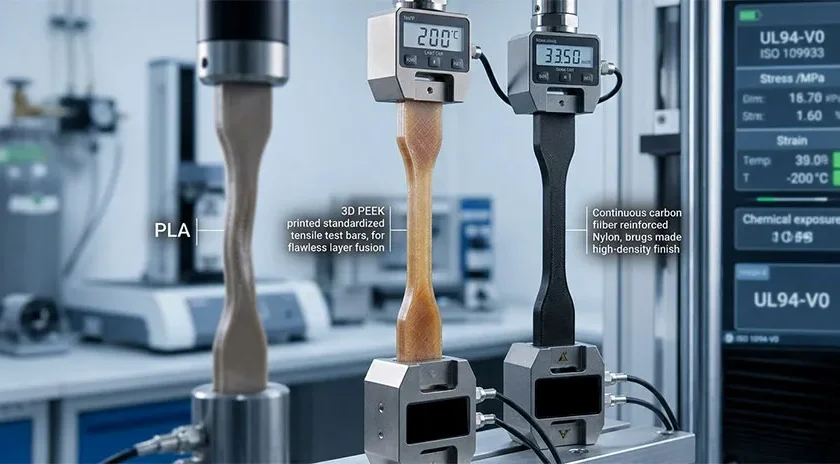
During the debate on Industrial 3D printing vs. home 3D printing, the material is the ultimate limiting factor. While the consumer market has remained stuck with low-temperature thermoplastics, the professional sector has opened the door to metal substitution using advanced polymers.
High-performance polymers (PEEK and Ultem)
We're talking about the top of the polymer pyramid. The PEEK (Polyether ether ketone) and the Ultem (PEI) These materials offer exceptional thermal and chemical resistance.
- Application: Capable of withstanding continuous operating temperatures exceeding 200°C.
- Industrial Advantage: They require printing chambers with active thermal control to prevent premature crystallization—a feature that only industrial-grade machines can provide to ensure that the part does not delaminate under stress.
Continuous carbon fiber composites
Unlike consumer-grade filaments, which contain carbon «powder» (which only provides structural rigidity), industrial printing allows for reinforcement with continuous carbon fiber. This transforms the part into a structural composite material with a strength-to-weight ratio greater than 6061-T6 aluminum, ideal for factory tooling or high-performance drone components.
Materials certified for medical and aerospace use
The key difference here is the traceability. A service like Justway provides certified materials that comply with specific regulations:
- UL94-V0: Flame-retardant certification, required for electrical and railway components.
- ISO 10993: Biocompatibility for medical devices that will come into contact with the skin or tissues.
- FDA: Compliance with food contact standards, ensuring that no toxic particles are released.
The Challenge of Transparency: Achieving Optical Clarity
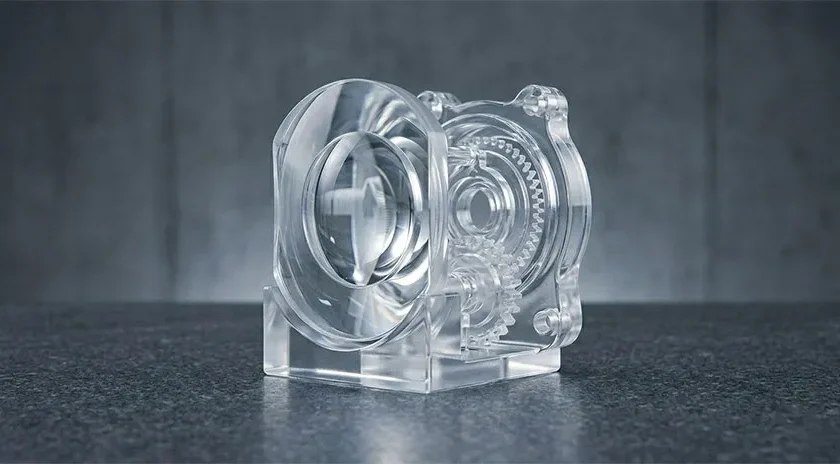
Achieving a transparent part in 3D printing is one of the most complex challenges in additive manufacturing. In a home setting, even with transparent resins, the result is often yellowish or cloudy due to light diffraction between layers. The industrial 3D printing It achieves this through a combination of materials chemistry and controlled curing processes.
High-resolution stereolithography (SLA)
Unlike desktop machines, industrial SLA systems use solid-state lasers with an extremely fine and stable spot size.
- Removal of microbubbles: Processing in vacuum chambers or using low-viscosity industrial resins ensures that there are no internal micro-voids that scatter light.
- UV stability: Professional-grade resins are formulated with photoinitiators that resist long-term yellowing, maintaining a constant refractive index—a critical factor for lighting components.
Crystal-clear post-processing
Transparency doesn't end at the printer; it begins in post-processing. To achieve a optical power, the piece must undergo a treatment that microscopically eliminates the «onion-skin» effect:
- Diamond or Mechanical Polishing: Removal of surface roughness down to the micron level.
- Dipping Coatings: A technical lacquer is applied to smooth out microscopic irregularities, resulting in a perfectly smooth surface that allows the visible spectrum to pass through without distortion.
- Result: Functional parts for light guides, infrared sensor housings, or glassware prototypes that are indistinguishable from injection-molded acrylic or glass.
Realism Without Assembly: The World of Multicolored and Multi-Material
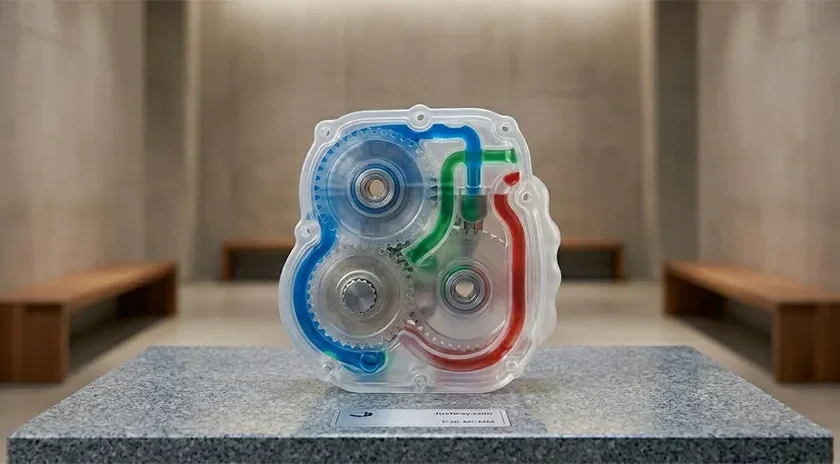
While domestic systems are limited by filament exchange (which results in purges and waste), industrial technology Photopolymer Injection (PolyJet) redefines what is possible in a single print.
PolyJet Technology: CMYK in Three Dimensions
Imagine a paper printer, but one that builds objects. This technology deposits microscopic droplets of different colors simultaneously.
- Perfect gradients: It allows you to render bitmaps and complex textures (such as wood, marble, or human skin) with photographic color accuracy.
- Visual Communication: It is the ultimate tool for product designers who need to validate the final design before investing thousands of dollars in injection molds.
A Fusion of Hardness Scales: From Rigid to Elastic
The real industrial advantage lies in the ability to combine different mechanical properties in a single part:
- Digital Materials: We can 3D-print an ergonomic handle that is rigid at its core but has a «soft-touch» (Shore A) coating on the outside, all in a single operation and without adhesives.
- Overmolding simulation: Ideal for testing waterproof seals, integrated O-rings, or bi-material housings designed to absorb impacts.
The ROI of Outsourcing: Why Invest in an Industrial Service in 2026?
When it comes to professional projects, the final decision usually depends on the ROI (Return on Investment). Simply put, ROI is a metric that tells us how much value we get back for every dollar or euro invested. In 3D printing, a positive ROI is measured not only in monetary terms, but also in Time-to-Market and in eliminating costly technical failures.
Access to capital-intensive technologies
For a company or a freelancer, purchasing a metal sintering machine or a PolyJet cell can require an investment of over $200,000, not including maintenance and specialized staff. Outsourcing to a service such as Justway It provides on-demand access to this cutting-edge technology, allowing you to pay only for the specific component and transform a massive fixed cost into a variable and controlled operating expense.
Reducing hidden costs and post-processing
The cost of a DIY print job is often misleading. When you factor in the man-hours spent on sanding, painting, and fixing printing errors, the actual cost skyrockets.
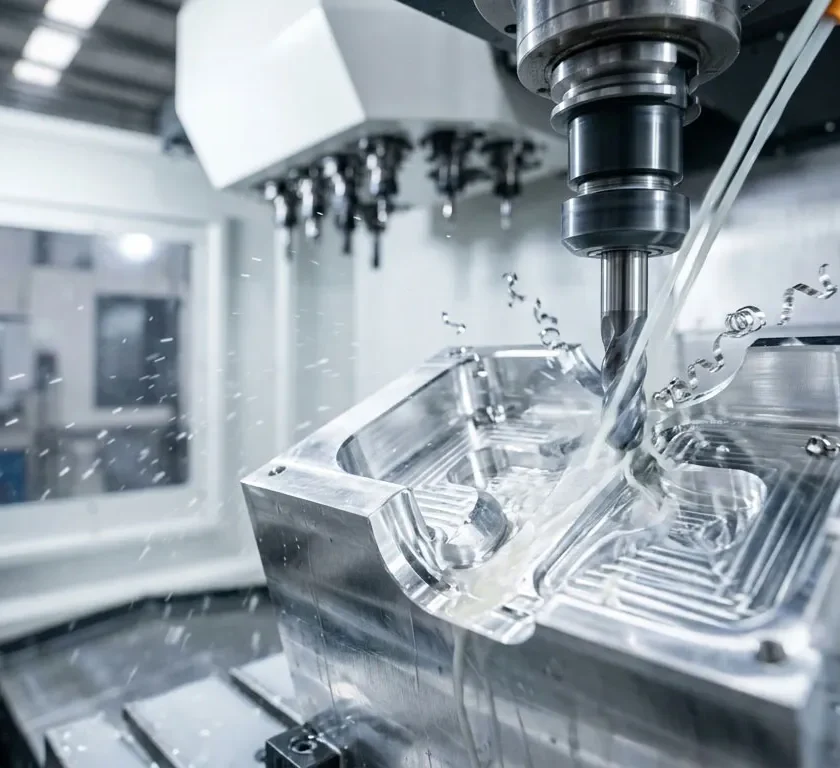
The industrial 3D printing We deliver finished parts with engineering-grade tolerances and finishes ready for their final application. This frees up your technical team to focus on what really matters: design and innovation, not machinery maintenance.
Conclusion: The Strategic Decision
By 2026, the question will no longer be whether you can print it at home, but whether your project can afford the risks of non-professional manufacturing.
For high-performance materials, optical transparency, and multicolored realism, industrial-grade equipment is the only way to ensure an irreplaceable result.
Are your 3D printers not delivering the quality your business needs? Try Justway.com's 3D printing service.
There comes a point in every professional project when desktop computers can no longer keep up with market demands.
If you're dealing with inconsistent tolerances, a shortage of technical materials, or finishes that require too many hours of manual labor, it's time to scale up your production.

Justway.com We're not just a supplier; we're the industrial partner your engineering or design department needs.
Why choose Justway for your critical projects?
- State-of-the-Art Infrastructure: Immediate access to industry-defining technologies, starting with DMLS (Direct Metal Laser Sintering) up to Large-format SLA and Multicolor PolyJet, without the capital investment that these machines require.
- Certified Quality Management: Unlike a local repair shop, Justway operates according to international standards, ensuring that every part undergoes rigorous quality checks before it reaches you.
- Instant and Global Quote: Its smart platform lets you upload your CAD files, get a quote in seconds, and manage international shipping logistics, eliminating administrative bottlenecks.
- Scalability: Whether you need a single optical-grade prototype or a run of 1,000 final parts with an automotive-grade finish, Justway has the operational capacity to meet your most demanding deadlines.
From digital file to finished piece in record time
The real advantage of Justway It's peace of mind. By outsourcing manufacturing, you ensure that the final product will have the strength, precision, and aesthetics that your company needs to compete at the highest level.
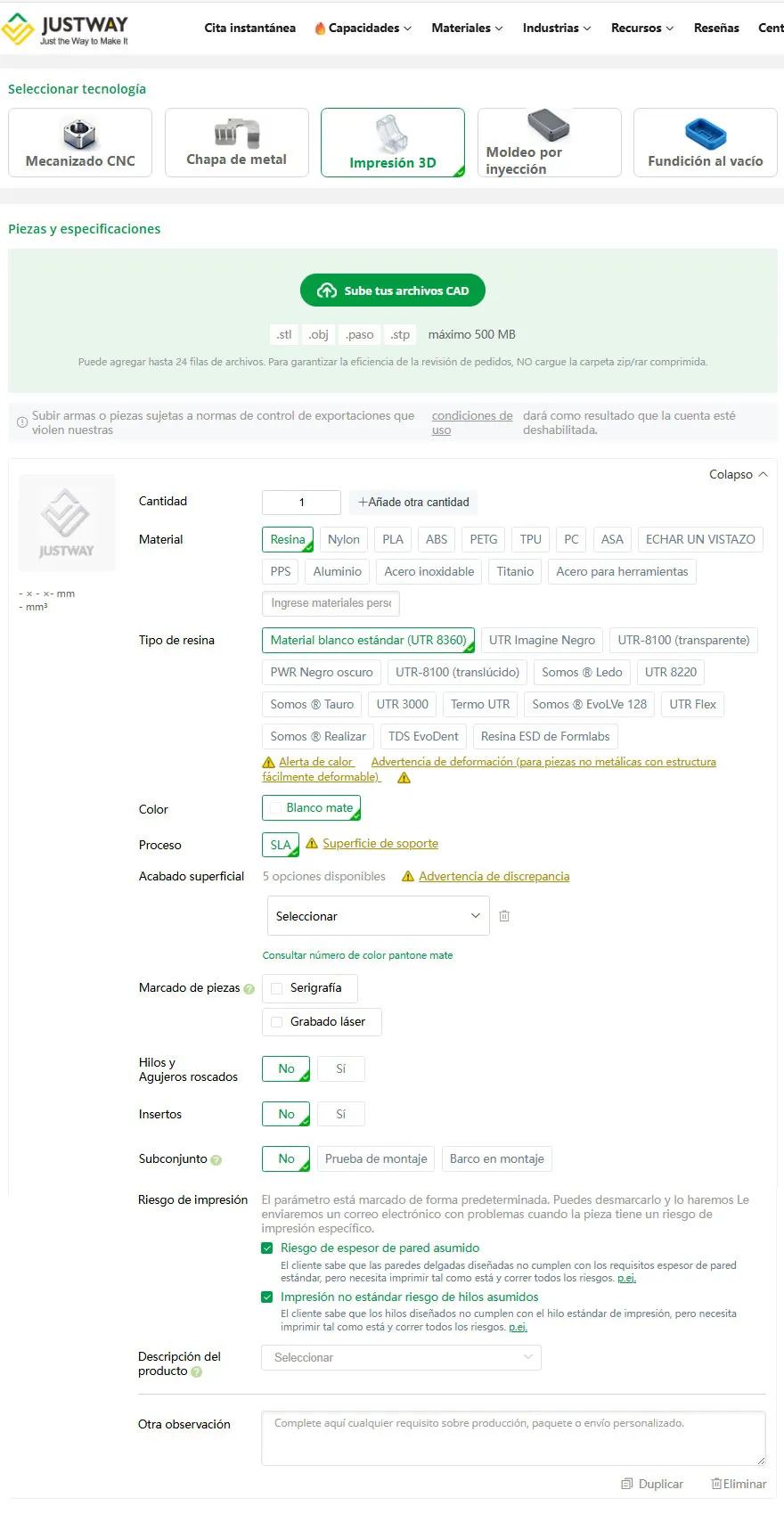
Don't let the limitations of a home printer hold you back from innovating.
It's your turn to share your thoughts!
The gap between home and industrial 3D printing is narrowing in terms of accessibility, but widening in terms of results. Have you ever had to outsource the production of your designs to achieve a professional standard, or have you managed to get the most out of your desktop printer using some post-processing tricks?
If you want to play an active role in the evolution of additive manufacturing, exchange ideas with other industry professionals, and gain access to exclusive features, Sign up on our website. Join the largest 3D printing community in the region!
Leave a comment below and share your experience with the community.


Responses