
Injection Molding vs. Silicone Molds (Vacuum Casting): Which Should You Choose for Low-Volume Production?

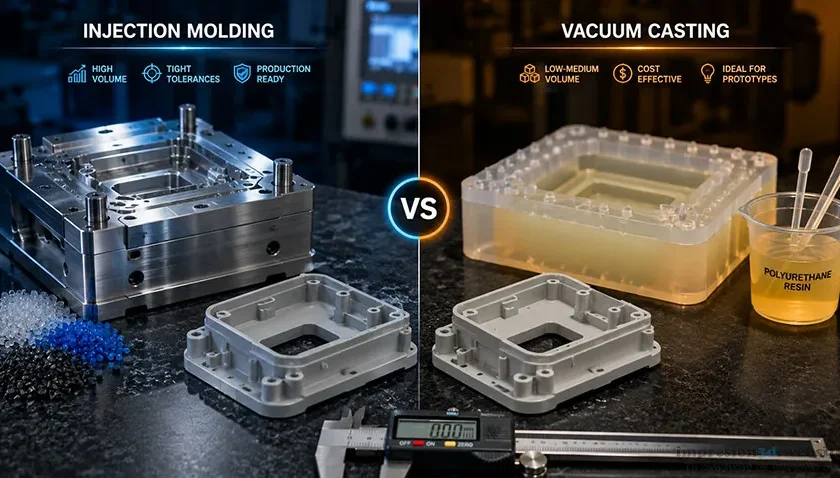
In modern product development, there is a critical phase known as the «gray area» of manufacturing: that point where you’ve moved beyond the initial prototype stage but don’t need (or can’t afford) to produce tens of thousands of units. Whether it’s to launch a market test, manufacture a short run of medical devices, or produce specialized replacement parts, the need to source between 10 and 5,000 units with final market-ready quality is a constant challenge for designers and engineers.
This is where the major technical debate arises: Should you choose silicone molds (Vacuum Casting) or make the switch to injection molding?
On the one hand, the injection molding It has historically been the undisputed leader in plastics manufacturing, offering unbeatable cost per unit and superior mechanical properties. However, the high initial costs of tooling (steel or aluminum molds) and long lead times can put a strain on any project’s budget and schedule.
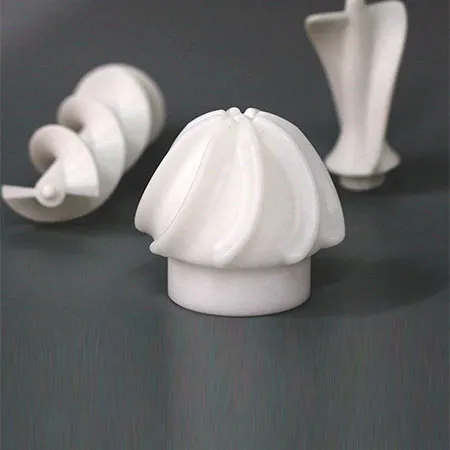
On the other hand, the silicone molds (Vacuum Casting) They have established themselves as the agile and cost-effective solution par excellence for short runs. They make it possible to replicate complex geometries with commercial-grade aesthetic finishes and properties that closely mimic those of engineering plastics—at a fraction of the initial cost of a metal mold and in a matter of days.
The goal of this guide is to demystify both technologies. We’ll take an in-depth look at how each process works, compare their costs, materials, and turnaround times, and give you the key tools you need to choose the best technical and financial option for your project.
Understanding the Technologies: How Does Each Process Work?
To make the best technical decision, it is first essential to understand exactly what happens inside the matrix during each of these processes and what their mechanical limits are.
Silicone Molds (Vacuum Casting)
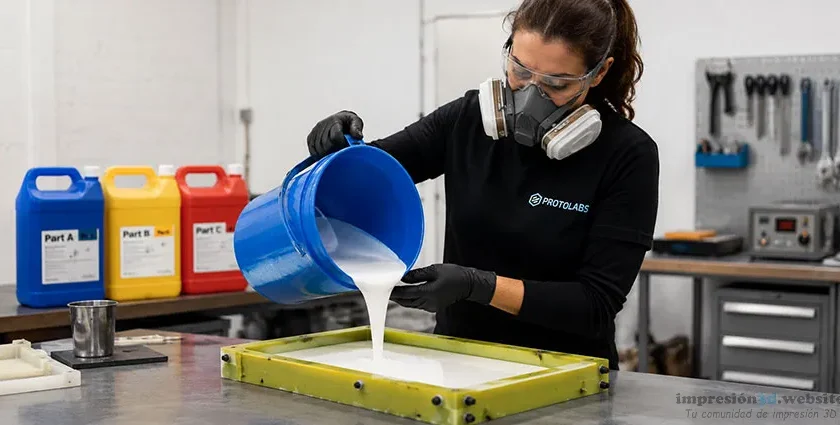
He Vacuum Casting Vacuum casting is an indirect molding process. It does not inject plastic at high pressure; instead, it uses gravity and a vacuum chamber to fill a flexible mold with liquid resins.
- The process: It all starts with a master model (master model), which is typically manufactured using high-resolution 3D printing or CNC machining. This model is suspended inside a box, and liquid silicone is poured around it. Once the silicone cures (solidifies), the block is carefully cut in half and the master model is removed, leaving an identical hollow cavity.
- Injection and curing: The two halves of the silicone mold are sealed together and placed in a vacuum chamber. A two-component polyurethane resin is then poured into the mold. The vacuum removes any trapped air bubbles, ensuring that the liquid fills even the most microscopic details. The mold is then transferred to an oven to accelerate thermal curing.
- Mold service life: Silicone is a soft material that gradually degrades due to chemical reactions in the resins. A single silicone mold typically lasts between 15 and 25 replicas before losing dimensional accuracy or tearing during demolding.
- Enlistment period (Lead Time): It's incredibly fast. A functional silicone mold can be created and ready for production in just 24 to 48 hours.
Traditional and Rapid Injection Molding (Rapid Tooling)
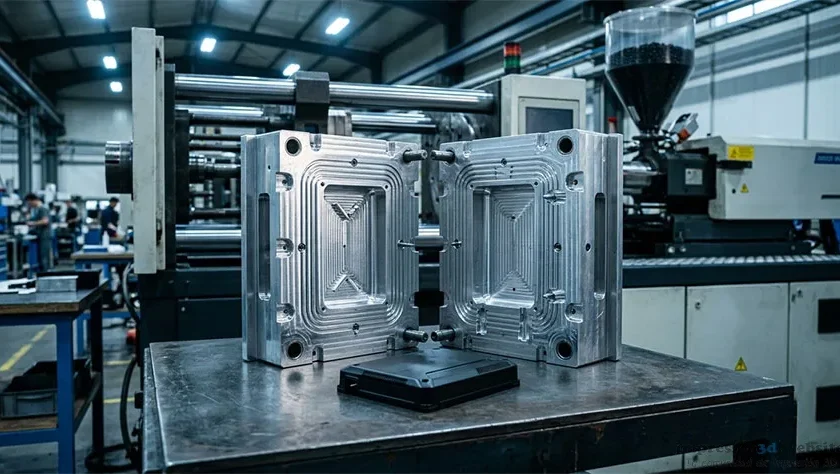
Injection molding is the gold standard for manufacturing mass-produced plastic components, based on the thermal processing of rigid thermoplastics.
- The process: Unlike vacuum casting, in this process plastic pellets are added (pellets) into a heated barrel where a screw melts them. This molten plastic is injected into extremely high pressures (which can exceed 1,000 bar) inside a rigid cavity formed by two metal blocks. The plastic cools rapidly inside the mold, and the part is ejected mechanically.
- Types of molds:
- Production molds (hardened steel): Designed to last for hundreds of thousands or millions of cycles. They require complex, high-precision CNC machining, electrical discharge machining (EDM), and polishing processes.
- Rapid Tooling or Aluminum Molds (Rapid Tooling): Specifically developed for low and medium volume. They use aerospace-grade aluminum alloys (such as P20 or Alumec) that are much easier and faster to machine than steel, offering a service life of 2,000 to 50,000 pieces.
- Enlistment period (Lead Time): The manufacture of a metal mold requires in-depth DFM analysis, the design of cooling channels and gate locations, and CNC machining. For a rapid aluminum mold, the lead time is typically around 2 and 4 weeks, whereas a steel one can take anywhere from 6 and 10 weeks.
The Technological Bridge: The Role of 3D Printing in Both Processes
Far from being competing technologies, additive manufacturing (3D printing) and molding methods complement each other to reduce costs and dramatically speed up development times in low-volume production.
3D Printing as a Master Pattern (Master Model) for Silicone Molds
The process of Vacuum Casting It depends entirely on the quality of the original model. This is where high-definition 3D printing becomes a cornerstone:
- Key technologies: The following are mainly used: Stereolithography (SLA) or technology PolyJet/Photojet. These 3D printers offer imperceptible layer heights (ranging from 15 to 25 microns) and perfect visual isotropy.
- Speed without CNC: Instead of spending hours on precision CNC machining to cut a pattern out of wood or aluminum, the master pattern is 3D-printed in photosensitive resin in a matter of hours.
- Post-processing finish: A technician post-processes the 3D-printed part (light sanding, polishing, or texturing) just once. That perfect finish will be exactly replicated on each of the 20 parts produced by the silicone mold.
3D-Printed Injection Molds: Low-Volume Hybridization
One of the most disruptive innovations in product development is the A hybrid approach combining 3D printing and injection molding (3D-Printed Tooling):
- What is it about?: Instead of machining a block of aluminum or steel, industrial 3D printers that use resin (SLA/DLP) or powder sintering (SLS/SAF) with high-heat-resistant polymers (such as ceramic-filled resins or PEEK) are used to directly print the mold cavities.
- Insertion into metal mold holders: These molded cavities are mounted inside a standardized steel mold base and installed in a conventional or benchtop injection molding machine.
- Ideal for functional validation: Allows you to inject true end-use thermoplastics (ABS, polypropylene, nylon, polycarbonate) to obtain between 10 and 100 pieces test.
- Extreme savings: It is the fastest and most cost-effective way to verify the flow properties of the actual plastic and the material's behavior before making the final investment in a metal mold.
Head-to-Head Comparison: Key Decision Factors
To determine which of the two technologies is best suited for your project, you need to analyze how they perform in terms of the four most critical operational variables: costs, time, materials, and finish.
A. Initial Costs (CAPEX) vs. Cost per Unit (OPEX)
The financial structure of the two methods is radically different:
- Silicone Molds (Vacuum Casting): They have a Very low CAPEX (Creating the silicone mold costs only a few hundred dollars.) However, its OPEX is high, since two-component polyurethane resin is expensive and the process requires skilled labor to pour and demold each piece.
- Injection Molding: It features a High or very high CAPEX due to the design and machining of the aluminum or steel mold (which can range from $2,000 to over $20,000 USD). In contrast, its OPEX is extremely low: the pellets Virgin plastic parts are inexpensive, and the injection molding cycle is almost 100% automated, taking just a few seconds.
The Break-Even Point (Break-even point): Typically, for volumes of 1 to 100 pieces, the Vacuum Casting It's unbeatable financially. Starting at 300 to 500 units, the amortized cost of a rapid aluminum mold begins to be more cost-effective than vacuum casting.
B. Delivery Times and Time to Market (Time to Market)
- Silicone: Ideal when speed is the top priority. Since it doesn't require complex machining, you can have the first 20 items delivered to your table in less than 5 to 7 business days.
- Injection: Even when using a quick-release aluminum mold (Rapid Tooling), the DFM design process, filling flow, CNC machining, and fit testing (T1 samples) takes between 2 and 4 weeks before starting production.
C. Mechanical Properties and Available Materials
- Silicone (Polyurethane Resins): Synthetic resins formulated for this purpose are used simulate the properties of real plastic. There are polyurethanes that mimic ABS, polypropylene (PP), rubber (Shore A hardness from 30 to 90), or clear polycarbonate. Although they are excellent for lightweight aesthetic and functional prototypes, they tend to be more brittle and have lower heat and UV resistance than the actual thermoplastic.
- Injection (True Thermoplastics): It allows you to use the full range of industrial-grade polymers: ABS, polyamides (nylon), polycarbonate (PC), PEEK, polypropylene (PP), POM (Delrin), and materials reinforced with glass or carbon fiber. It’s the only option if your part requires medical-grade certifications (FDA), flame retardancy (UL94), or high structural strength.
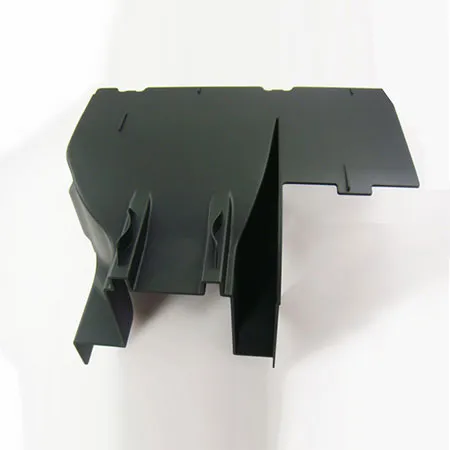
D. Surface Finish, Tolerances, and Aesthetic Details
- Silicone: It reproduces the texture of the master model with absolute accuracy (glossy, matte, Mold-Tech texture). Since no high pressures are applied, there are no sink marks or internal stresses. Typical tolerances are approximately $\pm0.2\text{ mm}$ (or $0.3\%$ of the dimension).
- Injection: It offers impeccable finishes and extreme dimensional consistency from part to part (tolerances of $\pm0.05\text{ mm}$ or higher). However, the design requires careful attention to the exit angles (draft angles) and a constant wall thickness to prevent sink marks or warping (warping).
Decision Matrix: Which One to Choose Based on the Number of Units?
To simplify the analysis and help you determine the best manufacturing route in a matter of seconds, we've summarized the variables related to volume, material, and lead times in the following comparison table:
| Production Volume | Recommended Technology | Estimated time | Main Advantage |
| 1 to 10 pieces | Direct 3D Printing (SLA / SLS / MJF) | 2–4 days | No tooling costs. Ideal for rapid design iterations. |
| 10 to 200 pieces | Silicone Molds (Vacuum Casting) | 5–10 days | Excellent aesthetic finish, low initial cost, and material simulation. |
| 200 to 1,000 pieces | 3D-Printed Molds / Rapid Aluminum Molding | 2–3 weeks | Transition zone. Enables the use of genuine thermoplastics with low CAPEX. |
| 1,000 to 10,000+ pieces | Injection Molding (Aluminum / Steel) | 3–6 weeks | The unit cost plummets. Maximum repeatability and mechanical strength. |
5. Typical Use Cases in the Industry
To put these concepts into practice, let’s analyze three common product development scenarios in which the choice of technology was decisive:
- 1. Aesthetic prototyping and market testing (Consumer electronics):A startup A company developing a smart bracelet needs 30 units with a flawless matte finish to present to investors and take photos for its catalog. Solution: Vacuum Casting. Using a single 3D-printed template and two silicone molds, they produced parts with a certain texture soft-touch and rubber overmolding in less than a week without risking capital on a metal mold.
- 2. Low-volume production for regulated sectors (medical devices):A company needs 300 enclosures for a piece of hospital diagnostic equipment that requires flammability certification UL94-V0 and resistance to cleaning chemicals. Solution: Rapid Injection Molding (Rapid Tooling (made of aluminum). Although the cost of the mold was higher, it was the only way to use the specific grade of certified polycarbonate/ABS required by medical regulations.
- 3. Pre-production validation on assembly lines (Automotive / Machinery):An industrial machinery manufacturer needs 100 glass-fiber-reinforced nylon connectors to test the assembly line while the final steel mold for 100,000 parts is being manufactured in Asia. Solution: 3D-Printed Injection Molds (3D-Printed Tooling). This made it possible to feed the final material into the workshop machine and validate the process without delaying the project schedule.
Do you need injection molding? Optimize your low-volume production with Justway.com

Choosing between silicone molds (Vacuum Casting) and injection molding doesn't have to be a shot-in-the-dark process. Partnering with a manufacturing provider that has experience in both technologies is the key to reducing risks, shortening time to market, and optimizing your project's costs.
In Justway.com They understand that each stage of the design process requires a different approach:
Instant DFM Analysis: Our platform automatically evaluates your CAD file to detect draft angles, wall thicknesses, and technical feasibility for both Vacuum Casting for injection.
- Flexibility in technologies: We seamlessly transition from rapid prototyping using 3D printing to vacuum casting or rapid aluminum tooling, tailoring our process to the exact size of your production run.
- Comprehensive Materials Management: We offer a wide range of industrial-grade polyurethane resins and thermoplastics with international certifications.
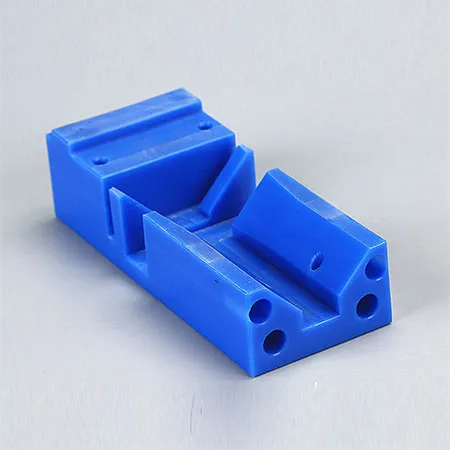
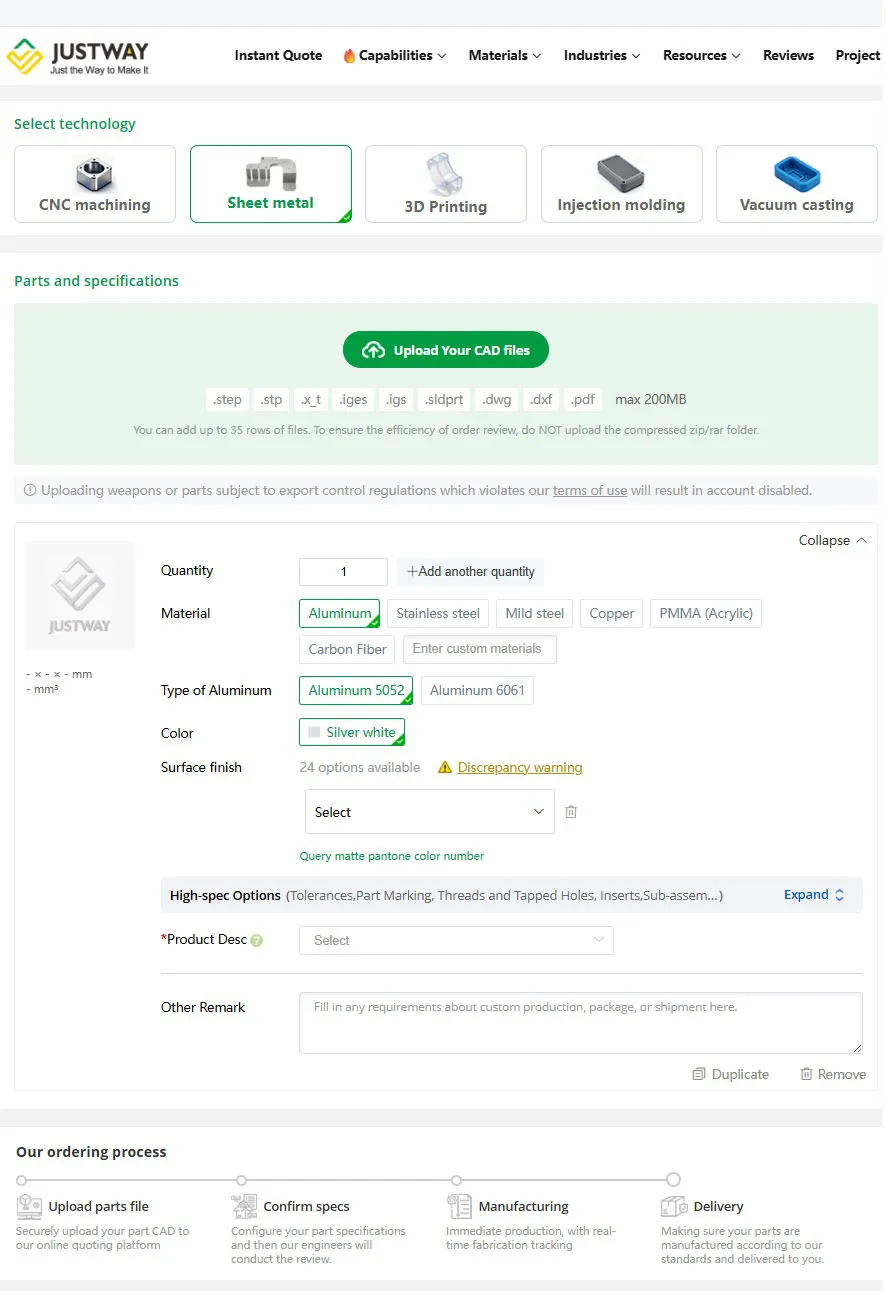
Instant quotes and automated DFM analysis in minutes
In rapid manufacturing, time is money. With Justway’s digital platform, you don’t have to wait days to receive a quote. When you upload your 3D CAD model, the system instantly evaluates the part’s geometry and generates a Design for Manufacturing (DFM) Analysis automated. This allows you to identify potential defects—such as insufficient draft angles, uneven wall thicknesses, or areas prone to sink marks—before manufacturing, ensuring that the design is 100% injection-moldable without costly rework.
Guaranteed scalability: From prototype to mass production
One of the biggest advantages of choosing Justway is the continuity of the project. You don't have to switch providers as your product scales. You can start with a short pre-production run using Rapid Tooling to validate the assembly and, as demand increases, seamlessly transition to multi-cavity steel molds for large-scale production. All of this is carried out under the supervision of the same ISO 9001-certified quality control and dimensional inspection team.
Flexible Rapid Tooling Solutions for Low- and Medium-Volume Production
Justway breaks down the barriers to entry in traditional tooling through the use of Rapid tooling made of aluminum and mild steel (Rapid Tooling). This technology is specifically optimized for short runs of 100 to 10,000 units, allowing you to cut initial fixed tooling costs by up to 50% and reduce lead times to just 2 or 3 weeks. It is the perfect solution for market validation, functional testing, or manufacturing small batches with mass-production quality.
Do you have a project in the works? Upload your CAD model to Justway.com and get an accurate quote along with the best technical recommendation for your parts in just a few minutes.
Conclusion and Selection Checklist
To make the final decision on your next low-volume project, use this brief checklist discard:
- Do you need fewer than 100 pieces quickly? ==>> Silicone Molds (Vacuum Casting). You'll save thousands of dollars on tooling and receive your parts in just a few days.
- Does your project require a specific engineering polymer (ABS, PC, fiber-reinforced nylon) or UL/FDA certifications? ==>> Injection Molding. Silicone only simulates the properties, while injection molding produces the actual material.
- Are you planning to scale up to thousands of units in the coming months? ==>> Injection Molding with Rapid Aluminum Molds. You'll recoup the cost of the mold within the first 300–500 units and pave the way for mass production.
- Do you need to validate the physical geometry before making a decision? ==>> 3D Printing (SLA / SLS). Create a master pattern or rapid prototype before investing in any type of mold.
Your turn! What's your favorite technology for short series?
The debate between financial flexibility and material performance is a daily reality for product engineering teams. Each project comes with its own budget, time, and performance constraints.
- Have you used Vacuum Casting For product launches, or would you rather invest directly in a rapid-prototyping aluminum mold?
- What challenges have you faced when trying to simulate a thermoplastic using polyurethane resins?
Leave us a comment below and join the conversation. In 3dprinting.website We're passionate about analyzing the technologies that are transforming modern manufacturing. And if you found this article helpful, share it with your team to help them optimize their next low-volume production run!
Responses