
California Bill AB 2047: Is the Freedom of 3D Printing and CNC Coming to an End?

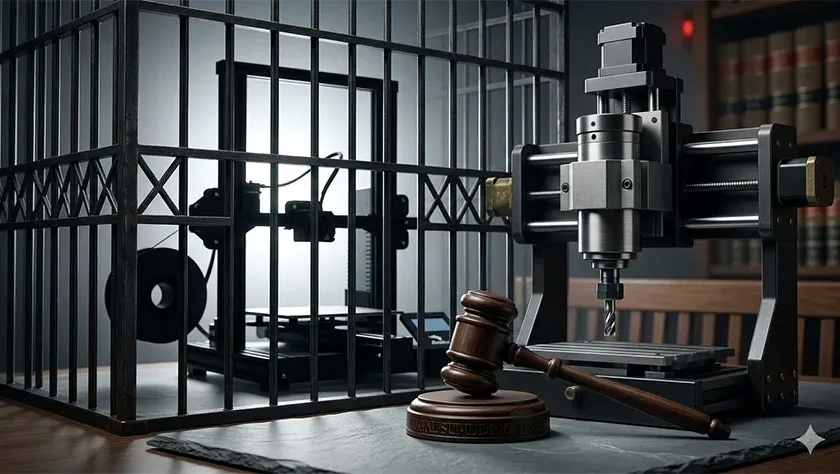
Digital manufacturing is facing its most significant legal challenge to date. In the state of California, the technological epicenter of the U.S., a debate is underway over the Assembly Bill 2047 (AB 2047), a bill that seeks to strictly regulate the sale and possession of 3D printers and CNC machines. What began as an effort to control homemade firearms could end up being a game-changer for engineers, makers, and companies around the world.
What is AB 2047, and why is it being introduced now?
To understand this law, we need to talk about «ghost weapons» (ghost guns). These are firearms that lack serial numbers and are manufactured privately, often using additive manufacturing (3D printing) or subtractive manufacturing (CNC) technologies.
Due to the increasing use of these weapons in security incidents, California lawmakers have proposed the AB 2047. The stated goal is to prevent individuals who are legally prohibited from possessing firearms from using advanced technology to manufacture them in the privacy of their homes or workshops.
The End of Anonymity in Machinery Purchases
The most critical aspect of the law is that it proposes treating 3D printers and high-precision CNC machines in a similar manner to the sale of chemical precursors or weapons:
- Mandatory Registration: Sellers must verify the buyer's identity using official documents.
- Criminal Record: The possibility of conducting background checks before authorizing the sale of certain machines is being considered.
- Report to the Authorities: Transactions must be reported to the state Department of Justice.
The big debate: What defines a «Weapons Manufacturing Machine»?
The biggest problem with the AB 2047 it is not his intention, but his technical ambiguity. The law seeks to regulate machines that have the «primary function» of manufacturing weapon components or that are «specifically capable» of doing so.
The dual-use dilemma
Like any expert in 3dprinting.website You see, a 5-axis CNC machine or an industrial FDM printer are «dual-use» tools. The same machine that can manufacture a component for a medical ventilator or a rescue drone is technically capable of manufacturing the mechanism housing for a firearm.
- Legal Uncertainty: If the law does not define with technical precision (microns, spindle power, type of material) which machines are affected, thousands of legitimate prototyping shops could fall into a legal gray area.
- Impact on Innovation: Fear of legal liability could cause major manufacturers to stop selling their most advanced equipment in California, thereby slowing down the region's technological development.
How does this affect the on-demand manufacturing sector?
It is important to note that, for now, this regulation focuses on the physical machine property. Cloud-based and on-demand manufacturing services (such as those we analyze in our rankings of suppliers in China) operate under a different framework.
However, the «domino effect» is real. If California implements these restrictions, it is highly likely that other states—and even European countries—will follow suit. This could force global platforms to implement much more rigorous identity verification systems, even for orders of single items.
Youtube channel: 3D Printing Nerd
Conclusion: Public safety or monitored digital manufacturing?
The AB 2047 It opens up a necessary but dangerous debate. While authorities seek to close the legal loophole regarding "ghost guns," the technical community warns of the risk of criminalizing tools that are driving the new industrial revolution.
The AB 2047 in California marks a historic turning point. Unlike previous regulations, this proposal does not seek merely to regulate the final product, but to intervene directly in the tools and software. As we move into 2026, the industry faces the difficult task of balancing public safety with the right to innovation and open source.
It is essential to understand that, even though this law is being debated thousands of miles away, the technical precedent it sets (especially the use of mandatory blocking algorithms) could reshape how Chinese and European manufacturers design the machines we buy at Argentina, Spain, or Mexico.
It is your voice that builds this community
In 3dprinting.website, Our mission is to ensure that technology remains a tool for empowerment, not surveillance. But to defend this ecosystem, we must first be informed and united.
- What do you think? Do you think these restrictions are a necessary safety measure or a «Trojan horse» designed to limit the freedom of the maker movement?
- Are you a professional in the industry? Tell us how you think requiring the use of proprietary, closed-source software on your CNC or 3D machines would affect your workflow.
Leave your comment below and share this article to spark a discussion
Don't miss our exclusive coverage:
If this is a concern for you, we recommend that you continue exploring ways to safeguard your production capacity in 2026:
Responses